
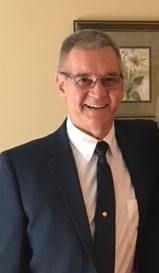
My father died at 2:56 PM on November 6 after an amazingly courageous two-and-a-half-year battle with pancreatic cancer. The following recounts the last 6 days of his life and the ensuing 4 weeks of my coming to terms with his death and…I don’t know, lots of other stuff. It goes deep and it’s pretty long, so bear with me or scroll on by. I just needed to write it out before it consumed me.*
[*Also, please note this was written over the course of a few weeks and after varying levels of consumption of wine and Xanax, so if it seems fairly disjointed at times, well I was fairly disjointed at times, so that’s probably why.]
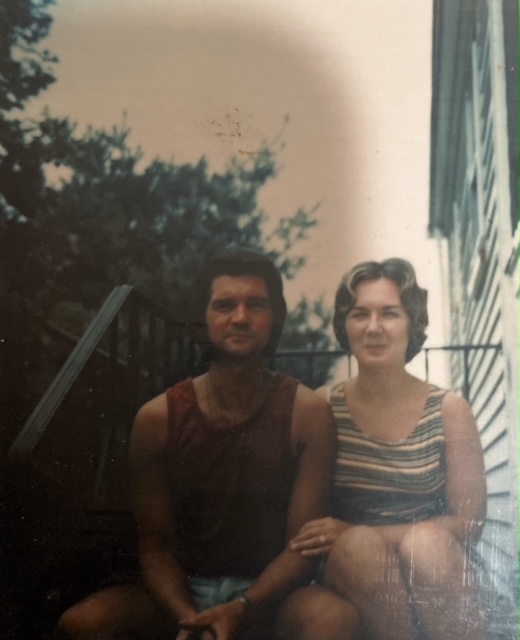
At age 16, my father finished his A-levels in Bristol, England–the equivalent of our meeting high school graduation requirements–and started his apprenticeship as a tool and die maker. Six years later he moved to the US. He met my mom on Cape Cod on July 3, 1970; they got engaged exactly one week later, on July 10; they married the following May; and had me the following March. Their love story is the stuff fairytales are made of.
My father was a man’s man and the ultimate girl dad. When I think of my childhood, I remember him coming home from work smelling like grease and steel chips after a long day of doing whatever it was he did at his shop in Hingham. He worked until the day he was diagnosed with pancreatic cancer, and I remember distinctly how I missed that smell on his jeans and work shirts when I washed them after he stopped working.
My parents have lived with my husband, son, and I for years. I thank God for that, because, among other things, it afforded me the opportunity to get to know my father on a level I never had once he was diagnosed and was home with us all day, every day.
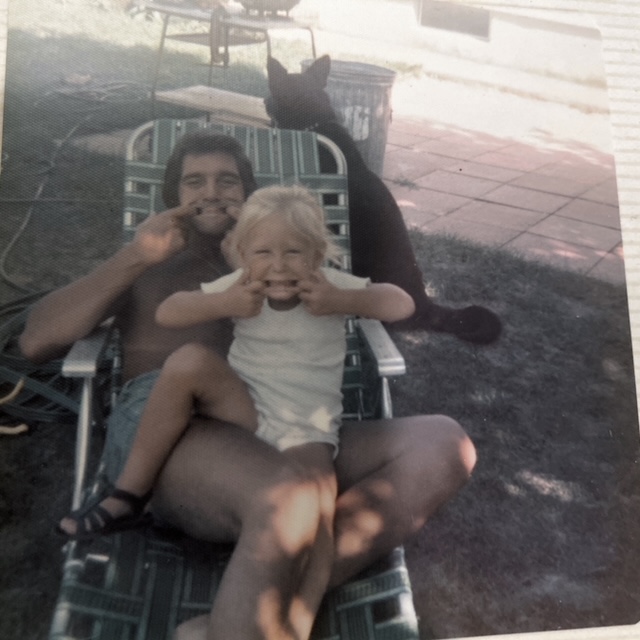
My father owned a tool and die business for years and he worked ridiculously long hours. I didn’t know him particularly well as a child, but when he was home, he was my playmate. We loved Saturday morning cartoons and the Sunday comics. I remember as a little kid watching The Benny Hill Show with him, which probably definitely wasn’t appropriate for my age, but he really wanted me to develop an English sense of humor and I think to some extent I certainly did. We loved Star Trek and Star Wars and Three’s Company, Gilligan’s Island, and The Carol Burnett Show. We loved to laugh, and we shared the same fairly twisted sense of humor.
He had an amazing voice and he used to sing to me the same old English songs that his father sang to him. He had the soulful voice of Dean Martin and slapstick comedic timing of Jerry Lewis. My father was funny. Mostly intentionally, but sometimes not. He perpetually got familiar sayings so wrong that I would bust a gut laughing at the absurdity of it. He was quiet, handsome, and strong.
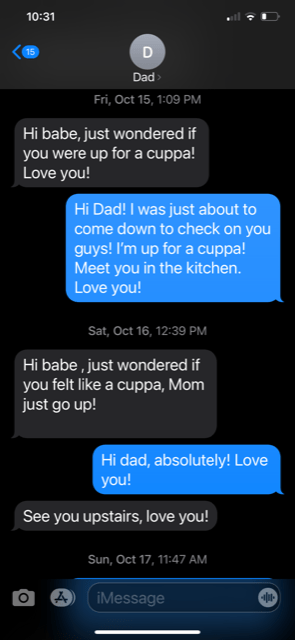
We shared a deep love of our morning tea and when he got sick, he started texting me every morning from downstairs to ask if I was ready for a cuppa. I’d go down to the kitchen to start boiling the water and set the table, and he and my mom would come up and we’d often spend an hour or 2 enjoying our tea, telling stories, trying to make each other laugh. He loved to read the sayings on his Salada tea bags.
Each text he sent me, whether it was to ask if I was ready for our morning cuppa or to say goodnight at the end of the day, ended with him writing “I love you.” I ended my texts to him the same way. It didn’t matter what the content of the message was, we always signed off with “I love you.” I have two and half years of those texts from him and I so treasure each and every one.
Early last August we found out that the treatment my father had been receiving was no longer working and that the cancer had spread to his lungs. He stopped treatment and he was put on hospice care. Thus began this final arduous journey.
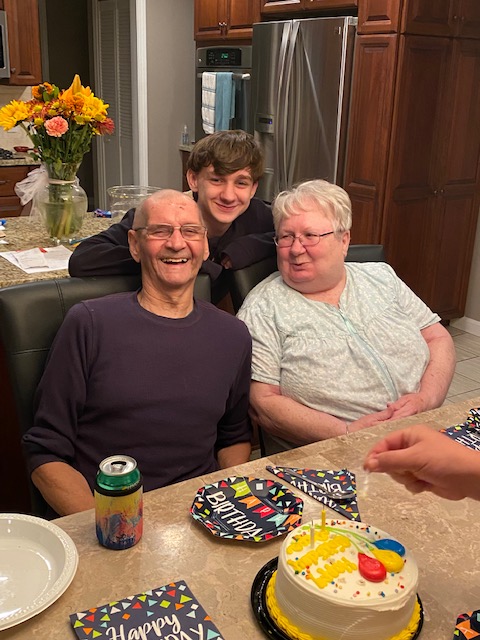
August and September were good. My father had more good days than bad and we honestly believed that we’d likely have until at least next spring with him. In mid-September he was able to attend our Rise Against ALS fundraiser, and he had an amazing time being out, enjoying the night with friends and family for a cause that was so important to him. We celebrated his 75th birthday on September 30. In mid-October, we got to make amazing memories with him when Paul Wahlberg came to the house and cooked a phenomenal six-course meal for us. Aside from the delectable food, which my father was able to eat and thoroughly enjoy–despite his appetite having diminished some in the days leading up to the dinner–my dad really hit it off with Paul, and they spent quite some time talking about their dogs and my father’s former business in the Hingham Shipyard, where Paul currently owns two restaurants. In fact, we made plans to take a trip to his old stomping ground and tour the area before going to Alma Nove for another amazing meal. I assumed he’d be here for Thanksgiving, for Christmas, and to celebrate my 50th birthday in March. How wrong I was.
The last couple of weeks of October brought an amazingly rapid decline in my father’s health. We were shocked at how quickly it all happened. By Halloween, despite my brain’s insistence on denying what I could clearly see happening, I knew in my soul that my father was dying, and I became utterly determined to make sure I was with him on this last part of his journey.
So, on Halloween night, after having spent the early part of the evening handing out over 400 candy bars to neighborhood kids and then visiting with some friends, I came home and went down to see how my father was doing. Something deep within me told me that things weren’t good and so I went upstairs and collected my pajamas, my iPad, my blanket and pillow, and I moved into my parent’s apartment. I didn’t know how long I’d stay down there; I just knew I had to be there. As it turned out, it was just 6 days. Six days of being with my father 24 hours a day. Six days of praying, begging, bargaining, crying, laughing, holding his hand, watching him die. It was six days that changed me forever.
My father had been on 24-hour oxygen for several days before I moved downstairs to be with him. The day the oxygen concentrator was delivered we happened to have one of the biggest storms we’ve ever had, and it knocked power out for over 30 hours. Not good if the oxygen you’re relying on to breathe is being delivered via a concentrator that relies on electricity to, you know, work. My mother uses oxygen at night with her CPAP machine and fortunately she happened to have a fair number of portable containers and so every few hours during the outage I would go downstairs to help switch out containers for him. The power finally came back sometime on the afternoon of October 28th, and so by the time I had gone down there to stay on the 31st, he was breathing fairly comfortably and continuously without the interruption of us having to remove the nasal cannulas and change the container.
For months, my father had been sleeping on the couch in the living room where he could recline just enough to be comfortable. Lying flat in bed had become far too painful for him, so this was a good alternative. So when I moved down with them, I took up residence on the recliner next to the couch. This might be the most uncomfortable chair I’ve ever sat in, but fortunately it was much better to sleep in when it was fully reclined.
My first night down there, I wasn’t even sure what to do with myself. My mom went into bed sometime around midnight and I settled in and found myself just watching my father. I did this for hours until the sun had just started to rise and then I finally fell asleep for a few hours. That was the last stretch of sleep I’d have for the next week.
When I woke up that morning, my father didn’t look good. It had been a couple of days since he’d eaten, and he’d only had a few sips of water since the day before. When the hospice nurse came, she increased his meds–morphine and lorazepam–and asked if we wanted a chaplain to come to administer the anointing of the sick. To my surprise, since neither of my parents are or have ever been particularly religious, he said yes. And so a priest from our local parish came that afternoon and it seemed to bring my father some peace. I think it was then that I knew that he had accepted what was happening, had come to terms with it, and wanted us to be able to do the same. I wanted to be able to accept it, for him. But the conflict within me raged as I struggled with the inevitable loss. My mind could wrap itself around the reality well enough, but my heart was breaking in ways that I can’t even describe. Heartbreak is indeed a true and real thing.
That night, knowing that my father had accepted his mortality, I became obsessed with the idea of being next to him and holding his hand when the time came. I didn’t want him to be alone when he took his last breath. I didn’t want it for him, and I didn’t want it for me. I also wanted to take hold of this opportunity to walk this final journey with my father in a way that would give him peace in death and give me peace in life. I’ve experienced a fair amount of loss in my life: friends, family, people I loved so dearly that their absence left a gaping hole in my life and changed me in fundamental ways. I have never experienced a loss that I was completely comfortable with, that it to say, that I felt no regrets about. Either the loss was so abrupt, as in the case of one of my closest friends, Paul, or it led to an inordinate amount of pain and separation and hurt and abandonment, as in the case of my grandmother, when my family essentially imploded, and some walked out of my life forever. After those losses, I was left reeling and flailing both in grief and anger and it took me a long time to work through it. You don’t get a second chance when someone dies. Things left unsaid are left unsaid forever, and that can change you in deeply profound ways. I wasn’t going to let that happen with my father.
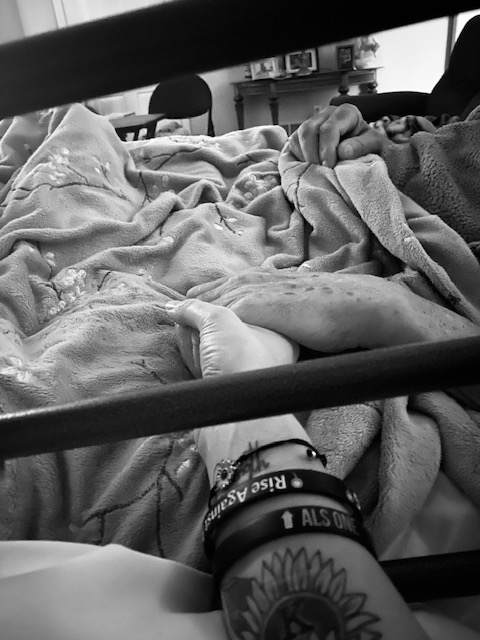
After my mom went to bed that night, I laid down on my chair, held my father’s hand, and just watched him. It was a routine that I continued throughout that week. I couldn’t take my eyes off him. I wanted the image of him seared into my memory because I knew all too well that those images can fade with time, and it was important to me that this one remain clear. And honestly, I was afraid that he would die the instant I averted my eyes. It was an irrational fear, but once it took a foothold, I couldn’t shake it. And so, I watched him.
The hours ran into one another, and time seemed to both speed up and stop completely. My mother and I spent Tuesday sitting on either side of my father, trying to get him to take some water, talking with him about nothing and about everything. At one point, my mother leaned in against him and he put his arm around her and started singing a song from his childhood in England. As tears streamed down her face and my father continued to sing softly to the woman he had loved so fiercely for 50 years, I picked up my phone and started recording. I had completely forgotten that I had recorded that beautiful, intimate moment until 2 days ago when I happened to see it on my camera roll. I smiled through my tears as I watched it over and over. At the end of the song, my father took hold of my mother’s hand and said simply, “I love you, darling.” Then he reached for my hand and repeated the phrase. I have never felt more blessed than I did watching and being able to relive that moment.
Tuesday night, my father was very restless. His body was exhausted, but he couldn’t, or didn’t want to, fall asleep. I kept asking if there was anything he needed, but he said he just wanted to talk. And so we stayed up for hours doing just that. At some point he decided that we’d talked enough, and he asked me to turn the television on. I scrolled through the guide and we saw that there was an NCIS marathon on, one of our favorite shows. So we watched that until well after the sun came up and he finally drifted off to sleep.
I’d only had about 2 hours sleep since Sunday and though I fought hard against it, I fell asleep as well. I woke with a start about an hour later and was horrified to discover that my father’s oxygen tubing had come loose and was down by his arm. I called out to him as I tried to extricate myself from the blankets and get to him so I could fix his oxygen.
“Dad,” I said. “Your oxygen came loose; I need to fix it.”
“I’m sorry, hun,” he answered. “I had to put up a real fight.”
I was utterly confused by his response. “You had to put up a fight? Why?”
“They wouldn’t give me any coconuts!” he exclaimed.
My father had been experiencing some hallucinations and a lot of confusion over the last couple of days. The nurse thought that perhaps the cancer had spread to his brain. She explained that the best thing to do was just go with it instead of trying to correct him because that might agitate him. And so I went with it.

“Who wouldn’t give you any coconuts, Dad?” I demanded. “I’ll fight them for you!”
“Thanks, love! I really do fancy a coconut,” he said, calming down and smiling at the knowledge that his daughter had his back in the fight for the coconuts.
I got his oxygen back in place and he fell back to sleep fairly quickly. Over the next couple of hours, he’d wake up several times, sometimes lucid, sometimes not so much. At one point he looked around the room in utter astonishment and asked when we’d put a pond in the living room. I told him I knew how much he liked to fish and so we thought we’d build a pond so he could fish right from the couch. He thought that was the cat’s meow!
Another time he was staring hard out the slider into the backyard, and he seemed utterly perplexed. I asked him what was wrong, and he kept pointing out back and asking what happened to our neighbor Bill’s house. When I asked what he meant, he pointed again and exclaimed, “It’s gone! Who took Bill’s house? Where! Will! He! Sleep!”
I calmed him down and assured him that the house was still there, it was just hard to see because we had the curtains partly drawn over the door. Satisfied that Bill was not going to be sleeping on the street, he once again fell back into a peaceful slumber.
Because he had not eaten or had much at all to drink over the last couple of days, my father had grown very weak. Only a few days before, he had been able to get up off the couch himself and walk himself through the bedroom and into the bathroom. But by now, he was too weak to pull himself off the couch. My mother has her own set of health issues and doesn’t have a lot of upper body strength. And obviously with my muscles weakened by ALS, I wasn’t much help. Working together, we’d been able to mange it up until now, but once he lost the ability to help at all we needed a new plan.
The nurse ordered a hospital bed, which would help facilitate washing, etc., because it could be raised and lowered with the push of a button. The bed came Wednesday afternoon and it brought with it a whole new grim reality. We knew the end was near, and late on Wednesday, my father could sense it too and that’s when he gave us the greatest gift in the world.
One by one, he asked us to sit with him so he could say goodbye and we could say whatever needed to be said between us. My mother, my husband, my son, and I all had our turn sitting with my father. We listened as he spoke, and then we had our chance. Those few precious moments with my father, when he was completely lucid and expressed his deep love for us all, brought an immense peace that helped ease the anguish.
Later that night, the doorbell rang and my husband went to answer it. I came into the foyer just as he was closing the door after collecting the food that we had ordered from a local pizza place. He turned to me and said that something had just flown by his head.
“Was it a moth?” I asked.
“It was too big to be a moth,” he answered. “I felt the wings brush against me.”
“Well, if it was a bat, we’re moving!” I cried.
With that, we both turned our attention upstairs and stared in amazement at the sight of a bird that had indeed flown in and perched itself on the doorframe of our son’s room. My husband and I looked at each wondering silently if we were both going crazy, and we started to make our way upstairs. As we ascended, the bird flew off into the direction of our bedroom. When we got to the top and looked into our room, we both stared in wonder at this bird that was now perched on the crucifix hanging over our bed.
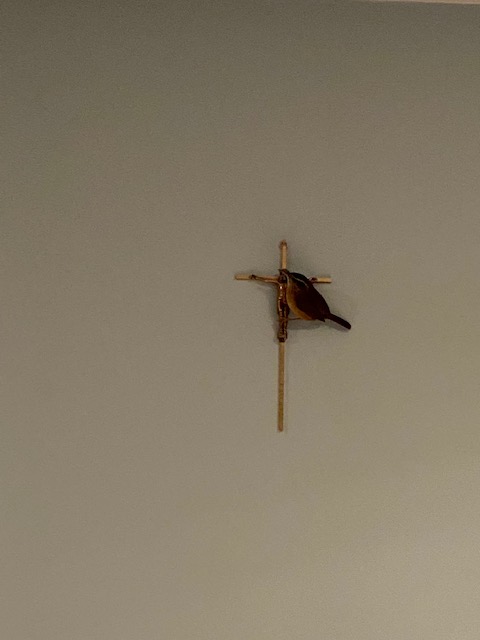
My husband and I had very different thoughts at that moment. His concern was getting the bird out of our house, while mine was, what the hell does it mean when a bird flies into your house and lands on a crucifix when you have a dying loved one two floors down!
So as my husband started to disassemble our window screen to try to shoo the bird out, I took to my phone and began searching for what this was a sign of. Because the bird didn’t die in the house and it wasn’t a white bird, there was no ominous meaning that I could find, and so I decided that this was a sign from God telling me that He was coming for my father soon, but that he was going to be OK. God was telling me that everything was going to be OK. And I knew that meant not that my father was going to be miraculously cured, but rather that he was going to be at peace, and so we should be at peace with that knowledge. And suddenly I was. A sense of calm came over me, and I returned to my parents’ apartment where I remained until my father passed away 3 days later.
Wednesday night was the last time any of us had any real conversation with my Dad. By Thursday morning, he was incredibly weak. He slept a lot of the day, though he occasionally woke up and when he did, he amazingly managed to crack a joke and make us laugh and cry at the same time. Each time he woke, we took the opportunity to tell him how much we loved him. And each time, he responded that he loved us too. And then he’d fall quiet again.
My mother stayed up late on Thursday, afraid, I think, that once she went to bed, she may not see him again. Around 2:00 in the morning I told her to go ahead in and promised that I’d get her if something happened. She agreed and went in to get some sleep while I settled in next to my father. I held his hand, determined again not to let it go during the night.
I listened to the cadence of his breathing and watched his chest rise and fall with each breath. His breathing had become more shallow over the course of the week. I sat and watched and tried to match my own breathing to his but found it too uncomfortable after only a couple of slow, shallow breaths. I watched him reach out and occasionally open his eyes and stare off at a scene that only he could see. His voice over the last several days had gone from fairly strong and clear to weak and eventually nearly indecipherable. Still, each time he opened his eyes I told him I loved him and waited silently for him to say it back. Each time he did, though it was getting harder to hear and understand.
By Friday morning, he was basically unresponsive. It had been several hours since I’d heard his last “I love you.” But I continued to tell him how much I loved him throughout the day, hoping he’d say it one more time. As the day wore on, my mother and I began to accept that we’d heard his voice for the last time and we just sat with him, preparing ourselves in whatever way we could.

The TV was on throughout the day and Friday night after the news, we flipped it to channel 5 to watch Jimmy Kimmel’s monologue. After hours of stillness and silence, my father suddenly popped his head up and exclaimed, “Hey! It’s Jimmy Kimmel!” Then put his head back on the pillow and was unresponsive once again.
“Seriously?” I said to my mother incredulously. “I’ve been trying to get an ‘I love you’ out of him all day and Jimmy freaking Kimmel gets his last shoutout! No way are my father’s last words going to be ‘Hey, it’s Jimmy Kimmel!” We both fell into a fit of laughter at the absurdity of it all, and at the knowledge that this was absolutely something my father would do.
About an hour later, my father opened his eyes for what would be the last time and whispered, “I love you,” in the faintest, most perfect speech ever.
The next 14 or so hours were among the most difficult in our lives as we sat with my Dad during the active stages of death. He was still all those hours, his hands by his sides, his mouth open, his breathing labored. He’d lost the ability to swallow and so as the saliva pooled at the back of his throat and he was unable to clear it, it made a horrifying gurgling sound. I was terrified that he would choke or drown in his own saliva. I couldn’t hold back my tears as I listened to this death rattle.
Katy, our amazing hospice nurse, assured us that he was not struggling and that he wasn’t in any pain. She pointed out that he wasn’t tensing up and his muscles were all very relaxed. She had us increase his meds to every 2 hours. This presented another problem for me. Because my Mom is legally blind, she couldn’t see well enough to administer the syringes into his mouth that held the meds that we dissolved in them. So I had been giving him the medicine. Which up until now had been fine. But since he could no longer swallow, I had to position the syringe at the inside of his cheek and push the plunger slowly so that we could rub his cheek and make sure he absorbed the meds and that he wouldn’t choke when the liquid went down his throat. This proved difficult for me with my limited hand mobility and so my Mom and I had to work together to accomplish the task. It seemed that no matter how slowly we administered the meds, he would start to cough and groan. I would dissolve into tears, apologizing to him, and assuring him that his would help him. It was a devastating cycle that we now had to repeat every 2 hours.
After an agonizing morning and afternoon, Dad passed away at 2:56 on Saturday, with Mom and I on either side of him holding his hands. His breathing had become more erratic and he seemed agitated, though he was not conscious. We talked to him gently and told him we loved him. I gave him a dose of morphine at 2:30 and less than half an hour later, he took one final, shallow breath and he was gone. Just like that. The journey that had started for this beautiful man, this husband, father, grandfather, and friend back in 1946, ended before our eyes 75 years later.
The next couple of hours are a blur. The hospice nurse arrived at some point to pronounce him. And the people from the funeral home came about an hour later to transport him. It all seemed so surreal. And then we were left alone to deal with the loss in whatever way we could.
I felt my body tense and I started to scream. It was a scream that came not from my throat or my lungs, but from somewhere deep within the shut-off places that we all carry inside. It was a scream that could expand and expand without end, and its source was equal parts sadness and anger, proliferated by the silence and pain of the past couple of years, the anguish of the last couple of weeks, and the ever-present fear. It was all I could do in that moment. Anything to break the silence that hung so heavy. And then it stopped and there was no more sound. Just tears rolling down my face as my chest rose and fell in silent sobs. I collapsed in a ball of heaping sobs, struggling to catch my breath as I contemplated this fresh loss, as I ruminated on this stuttered death that had stretched out so long ahead of my Dad, that stretches out so long ahead of me.
As I struggle to come to terms with this new reality, all I can do is write it out. I want to write of my desire to live, but it’s so raw right now that I hardly know where to start, except to say that my hunger for life is insatiable, but so too is my fear of it. A fear born from loss, deeply imbued. A fear whose birth I can directly pinpoint. The years which have intervened belong to that dark side of life in whose shadow I struggle to breathe. It is an affliction which poisons me at the zenith and the nadir of my being, no matter how gallantly I struggle against it.
THEN
My first significant loss, one that changed me on a fundamental level, was in 2006 when my grandmother succumbed to metastatic breast cancer. I was 8 months pregnant at the time and married to a man who was becoming increasingly angry and abusive. My grandmother died in April, my son was born in June, and I left my toxic marriage in November. On top of all that, my grandmother’s death led to a deep fracture within my extended family that resulted in the loss of some very important relationships in my life. As a result of all the hurt and betrayal and pain that came with all that nonsense, I started building walls of protection around me so as to avoid ever being hurt like that again. This led, apparently, to some kind of arrested development in my ability to grieve. And so, when my second significant loss, the sudden and unexpected death of one of my closest friends, happened 4 years later, I was absolutely shattered, and it took me years to recover from those events. Life went on, of course; what other choice was there? But those losses and the depth of my grief kept me from moving forward in any meaningful way. I lost years to grief and sorrow and anger. I walked through life in a haze. I don’t have the time to lose now.
Back when my grandmother died, I read a book called A Grief Observed, by C.S. Lewis. I can remember one passage that particularly struck me:
The agonies, the mad midnight moments, must, in the course of nature, die away. But what will follow? Just this apathy, this dead flatness? Does grief finally subside into boredom tinged by faint nausea?
Like Lewis, this too is what I feared most. A dull film appears over life when you lose someone you love. It becomes clearer with time, sure; but it’s always there. It’s worse even than the initial anguish of the loss. Worse because as the senses dull, so too does the ability to feel whole. As acute as the pain is, our ability to feel acute joy is ever weakened. It’s not that it ceases to exist, joy…it’s just that it’s forever less crisp than it once was.
NOW
I remember back to those days and that dullness and it’s not somewhere I care to return to. The loss of my father is devastating. There’s no denying that. But in the time between those losses and this, I have absolutely experienced joy…pure, colorful, crisp joy. And I realize that walking through life in a haze, being consumed by grief, is not only no way to live, it’s also no way to honor those loved ones we’ve lost. When I was diagnosed with ALS, I made a vow to live well and fully, no matter what. I allow myself to mourn the loss of abilities as they come, of course; but my focus is and has to be on what lies ahead, not what lies behind. I will honor my grandmother, Paul, my father, and all the others by living my life well and fully and by embracing joy.
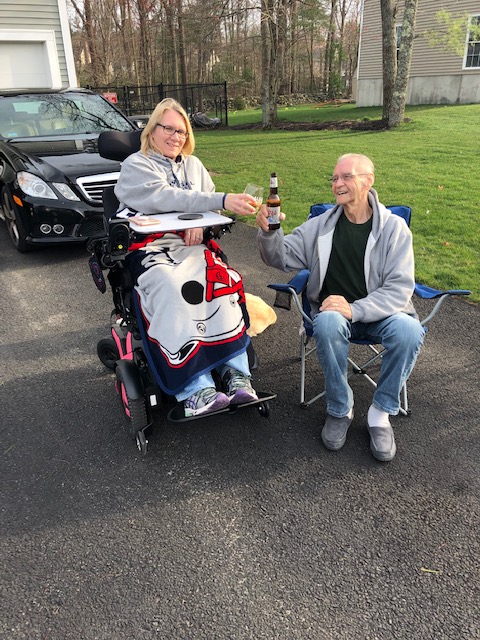
I’m turning 50 in three months. My father will not be here to celebrate with me. But he is with me every single day. I can’t control what happens in life; I can only control how I react to what happens. We were absolutely blessed to have two and a half years with my father after his diagnosis. I believe we made the most of that time and created some wonderful memories. And as horrible as the last couple of weeks of his life were, it was my privilege and honor to help care for him the way he had cared for me my whole life. I love you, Dad.

 Rise Against ALS!