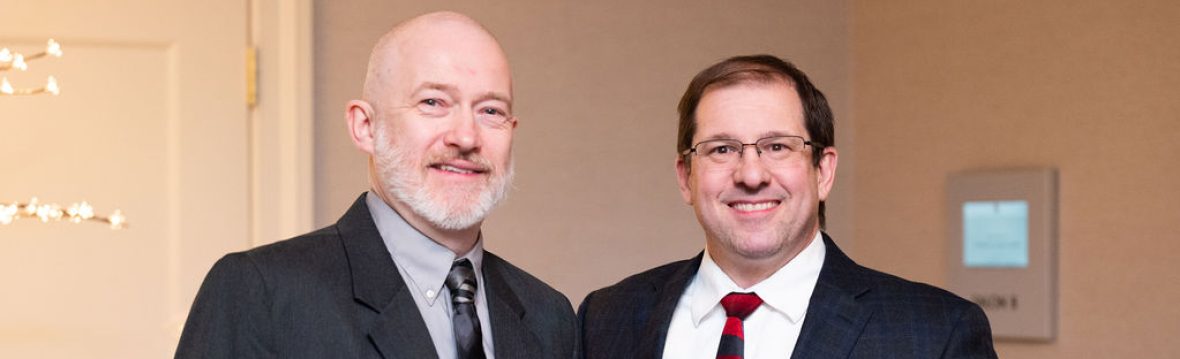
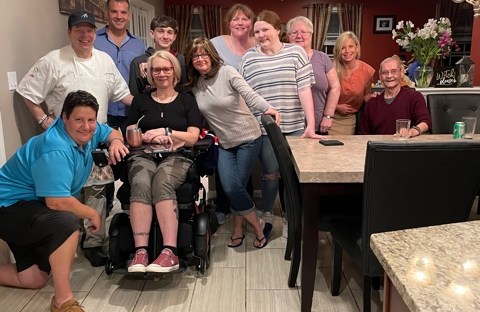
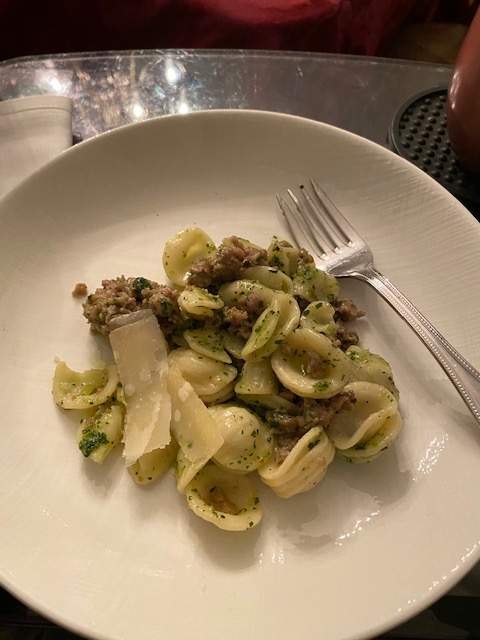
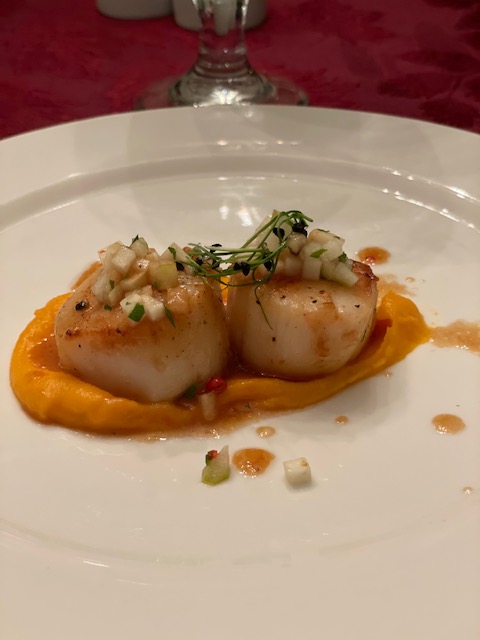
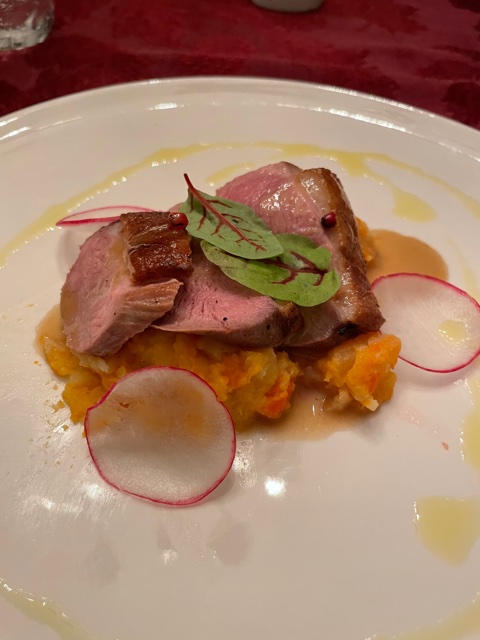
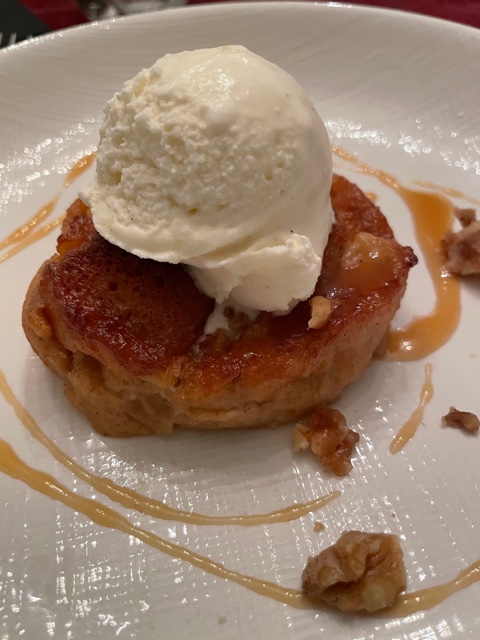
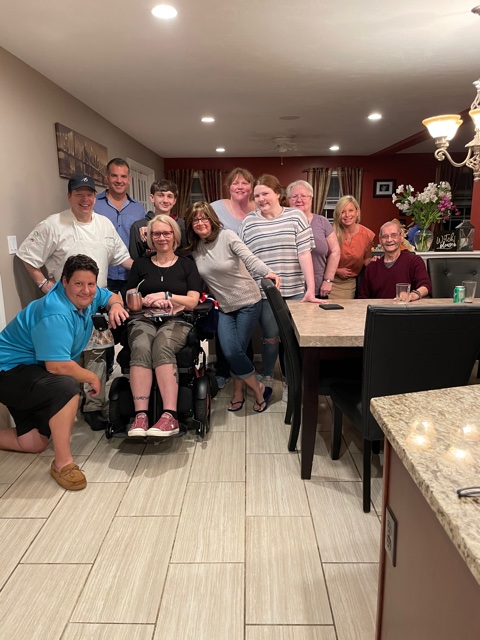
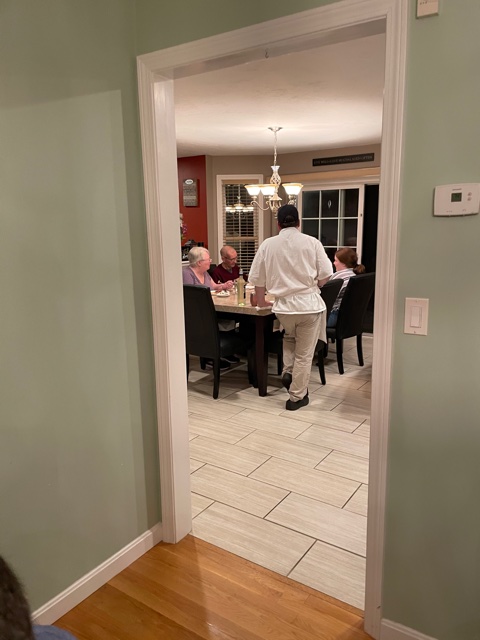
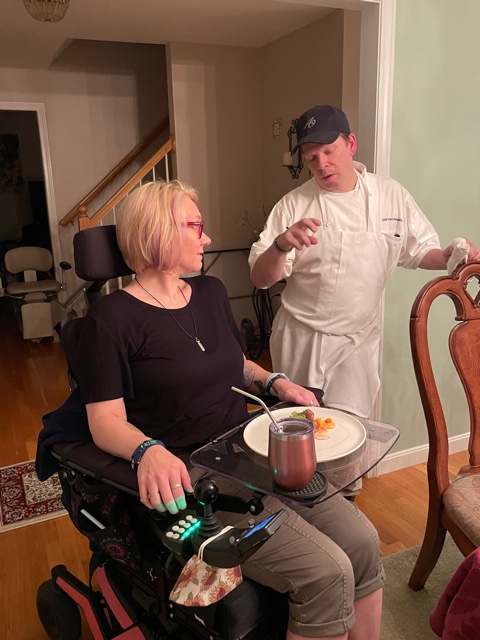
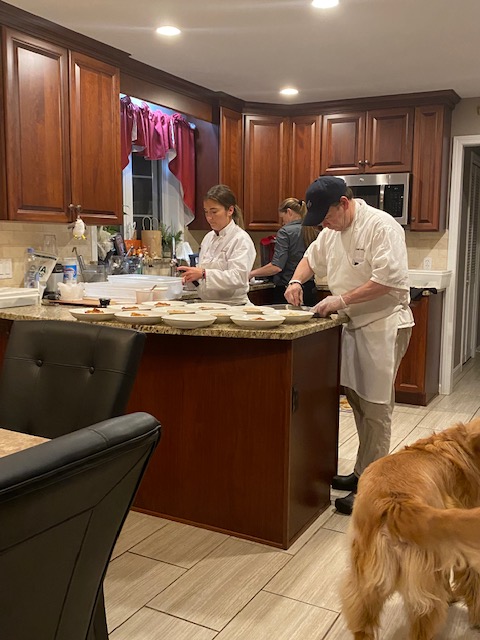
On October 12, Chef Paul Wahlberg, came to our home and prepared an absolutely stunning six-course meal. We were joined by my besties, Alana (and her daughter, Hailey) and Cheryl, and by our dear friends Jen and Bob. Jen is the executive of ALS ONE and she helped facilitate this amazing night.
The best part of the night, aside from the amazing food, of course, was watching my Dad, who hadn’t been feeling particularly well in the days leading up to the dinner, not only devour and thoroughly enjoy the meal, but connect with Paul and have a really amazing conversation with him.
Paul was incredibly gracious. I honestly cannot say enough about the man. Anyone who knows me knows about my love of all things New Kids on the Block. And that includes Paul’s brother Donnie. I’ve been a fan since the 80s, and I love going to see them in concert. And that will forever be true. But anyone who can make my Dad smile these days (and anyone who can get my 15-year-old son to eat anything besides Raman noodles!), well, they are number one in my book. Aside from providing us with what was arguably the best meal I’m quite sure any of us have ever had, Paul was just so incredibly gracious and down to earth.
After the meal, he sat and talked with us for quite a while. He and my Dad bonded over their love for their dogs and talked for some time about the Hingham Shipyard, where Paul has two restaurants and where once upon a time my father had a machine shop, long before it was built up and became the bustling commercial complex it is today.
My father hasn’t stopped talking about the dinner. In fact, after talking about the Hingham Shipyard, Paul had suggested to him that he come to Hingham so he can tour his old stomping ground and then have dinner at Alma Nove, and Dad is all about it!

A Brief Non-Sequitur (with a little history about the Hingham Shipyard)
I’m sitting in the back seat of my father’s 1975 blue diamond Lincoln Continental, the first rays of light creeping in from the open window next to me. It’s early summer and the car is hot; my bare legs stick to the cracked gray leather seats, and I can feel beads of sweat already starting to form on my neck. That I stick to the seat a little is probably a good thing since every turn my father makes would otherwise send me sliding across the width of the car. I don’t remember seat belts being mandatory back in the early 70s; I’m not even sure they were suggested. I do know that I was never buckled into them as a kid. I was either left to deal with centrifugal force in the back of my father’s Caddy, or better still I would crawl into the back of my best friend’s parent’s wood-paneled station wagon with several of our friends and make faces at the cars behind us through the dingy back window.
My father has the radio on as usual. Any time a radio is on in his car or in our house, it’s generally either playing the biggest artists of that time—Elton John, Billy Joel, Kenny Rogers, Queen—or it’s tuned to WBZ NewsRadio, channel 1030 on the AM dial. This morning, though, my father has an 8-track tape, a clunky 5.5x4x1-inch cassette, in the car’s player and it is belting out the songs of my father’s favorite musician: Dean Martin. My dad is enthusiastically singing along to “Volare,” hitting each note perfectly and pronouncing all the Italian lyrics as if it were his native tongue. He sways to the tune and taps on the steering wheel at all the appropriate times.
Dad glances back at me in the rear-view mirror and smiles. I smile broadly and sing the few words I know. I love when my father sings. He’s painfully shy and would never think of singing in front of anyone but his family, but my heart swells when he sings, and I nag him constantly to serenade me and my friends. His voice is as smooth as Dean Martin’s and if he hadn’t chosen engineering as a career, I believe he could have been quite the performer.
Alas, at 16 years old, my dad finished his A levels in Bristol, England, the equivalent of our meeting high school graduation requirements, and started his apprenticeship as a tool and die maker. Six years later he moved to the States. He met my mom on Cape Cod on July 3, 1970; they got engaged exactly one week later, on July 10; they married the following May; and had me the following March.
So, music wasn’t in the cards for my dad, but he was the hardest working man I know. When I was 2 years old, he started his own manufacturing business. He called it Tippit Products because he thought having a company name that was a palindrome was pretty cool. Years later he started a second company and called it ToMar Engineering, a combination of his and my mother’s first names: Tony and Margaret.
My father worked hard to build his business. Throughout my childhood, he worked 7 days a week, often late into the night. I loved my father, but I didn’t know him well as a child. Still, I jumped at any opportunity to be with him. We shared the same sense of humor, we both loved cartoons and Star Wars and ice cream, and more often than not any time we spent together included copious amounts of all of those things.
Dad woke me before the sun rose this morning. I had barely slept because I was so excited. He was taking me to work with him for the first time. I had been to his building before for brief visits, but he’d been promising me he’d take me with him on a Saturday when he knew he would only be there for half a day. Today was the day.
We make our way up the highway, the sun rising higher in the sky with each mile. We left our small ranch house in Braintree, a tony suburb less than 15 miles south of Boston, before 5 AM. Dad’s building is in Hingham, 8 miles northeast of Braintree. Specifically, the building is located in the Hingham Shipyard.
The Shipyard had its hey-day back in the early 1940s when Bethlehem Steel was commissioned to be the major contractor to bring to life a new fleet of ships called the Destroyer Escort that the Navy was designing during the early days of World War II. Bethlehem’s shipyards were at full capacity and Hingham was chosen as the site for a new shipyard. Its deep harbor and few existing buildings created a perfect environment for the job at hand, and within a year of its completion, 15,000 workers were employed in the yard. Over a 3-and-a-half-year period, they built 227 ships.
We pull into the dirt drive that runs parallel to my father’s building. Before we go to his work, he is taking me to the Pilot House restaurant for breakfast. This is where my father eats every morning, and I am excited to be included in his ritual today. We park in front of the run-down building and walk hand-in-hand inside. There are scattered tables throughout the large room, but my father directs me to the counter where he lifts me up on a tattered stool that is mercifully anchored to the ground.
The Pilot House is perched close to the water. It’s an old, dusty building that serves mostly fisherman and the blue-collar workers who toil alongside my father on a daily basis. I swing my legs from side to side, twisting the squeaky barstool first left, then right, then back again. I imagine we both order pancakes, as that is a particular favorite of ours.
Several men come up to say hello to my father as we finish our meal. People often come up to say hello to my father. He’s a quiet man, but people are drawn to him. The men who stop by this day are mostly older men, with thick beards and well-worn clothes. Most of the men smell like the ocean.
I sit, happy, next to my father. I look up at him as he talks, perhaps squinting hard against the dusty blast of coastal sun that now pours in through the floor-to-ceiling windows. I am content.

 Rise Against ALS!